Goldmund
Narcissus and GoldmundGoldmund is a restless seeker whose movement from monastery to road, from sensual experience to sculpture, tests whether a life can belong to both nature and spirit. The return of his mother’s image loosens the religious vocation imposed on him by his father; the wooden Madonna he encounters years later gives his wandering an artistic aim. His sculptures preserve faces and relationships that life cannot keep, but neither art nor monastic order entirely resolves his longing. He returns to Mariabronn sick and exhausted, telling Narcissus that he intends to stay and carve again.
Identity and Formation
Goldmund arrives at Mariabronn as an adolescent sent by his father to study at the cloister school. The monastery is more than a place of prayer: its halls and classrooms sustain teaching, administration, and a broad range of intellectual and artistic pursuits. Within this ordered community, Goldmund becomes especially devoted to Abbot Daniel and Brother Narcissus, two men whose unusual standing attracts notice throughout the house.
He regards Abbot Daniel as a saint and longs to serve him, drawn to the Abbot’s simplicity, attentive eyes, and humble manner of exercising authority. Goldmund imagines completing his education and remaining in the cloister indefinitely, giving his life to God. His devotion seems to unite his own youthful desire with his father’s command and what he takes to be God’s decision. Narcissus, meanwhile, becomes the friend whose insight will eventually expose the difference between the life Goldmund has been assigned and the life his nature demands.
The monastery itself accommodates a striking mixture of piety, learning, practical rule, and competing temperaments. Narcissus, though a novice, teaches Greek because of his gifts, but his position remains subordinate in the hierarchy. A dispute over teaching methods makes the distinction concrete: he argues forcefully for changes, while Father Lorenz reminds him that he is an assistant, not a colleague, and must obey his superior. Goldmund’s early world thus contains both intellectual vitality and firm institutional limits; its discipline offers purpose, but not every person within it has equal authority to define that purpose.
Awakening and Departure
Narcissus helps Goldmund recover a memory he had lost: the image of his mother. In the moment of recognition, the woman returns to him as a radiant, beloved presence, and his childhood seems to open again. Narcissus identifies the awakening as a recognition of the difference between mother-heritage and father-heritage, soul and mind. He argues that Goldmund’s aspiration to monkhood may not have been his own vocation at all, but an invention of his father, who wanted him to atone for or avenge himself on Goldmund’s absent mother.
This revelation changes the meaning of Goldmund’s religious commitment. He announces that he is leaving without his father’s permission and knows that his flight will bring shame upon Narcissus. His departure is not simply a rejection of his friend: Narcissus says their friendship has reached its first goal, Goldmund’s awakening, while expressing the hope that it may begin again and lead to other goals. But Narcissus cannot accompany him. He is bound to the cloister by his vows and believes his own purpose lies there. Their parting establishes a lasting contrast: Goldmund follows an uncertain call outward, while Narcissus commits himself to the order he has chosen.
On the road, Goldmund enters a life without fixed home, property, or obedience to a single authority. Weather and season shape the traveler’s circumstances; time, ambition, and settled history recede in favor of what arrives from moment to moment. This homelessness is freedom, but also exposure to hardship and chance. Goldmund’s journey is episodic rather than directed toward a secure destination, and its very openness allows many different experiences to shape him.
Love, Danger, and the Call of Art
Goldmund’s relations with women develop through receptivity and a continuing appetite for experience. He is drawn especially to young women who seem protected and inaccessible, but he also learns from the women he encounters. Each relationship leaves him with a distinct memory of gesture, affection, or reserve. The account presents his appeal not as beauty alone but as an inquisitive, childlike openness: he is pliable and responsive to what another person wishes of him. Love, in this phase of his life, is both an encounter with others and an education in human variety.
A song heard during his wandering brings together several of the people and forces that remain in his mind: Lydia, Narcissus, and his mother. Its music mingles with the wind’s suggestion of strife, autumn, and the homeless life, leaving his heart full and unsettled. The passage gathers his past attachments without resolving them. He is moving onward, but memory travels with him.
His companionship with Viktor brings a more immediate danger. When Viktor attacks him, Goldmund fights for his life and uses a small hunting knife to escape. The encounter gives him his first direct taste of the fear of death. Later, he distinguishes this danger, against which a person can struggle, from plague, which cannot be fought in the same way. The contrast marks a change in his understanding of mortality: survival can depend on action, but not every threat offers an opponent whom courage or force can defeat.
The decisive turn toward sculpture begins with an image. In a church, Goldmund sees a wooden Madonna in a side chapel. Her blue cloak, forward-leaning posture, delicate hand, and living expression draw him into sustained, reverent attention. The priest tells him that the statue, made by Master Niklaus and given to the order by a benefactor, has provoked controversy: some consider it too modern and worldly. Goldmund’s response is different. He leaves the church with a goal for the first time, resolved to seek the master and learn the art that has made the figure so compelling.
Sculpture, Memory, and Departure
Under Master Niklaus, Goldmund develops as a draftsman and is allowed to try modeling clay as well as carving wood. His first successful work is a clay figure of Julie, Lydia’s sister, about two spans high. Niklaus praises it but refuses Goldmund’s request to have it cast in metal, judging it too worldly and unchaste. The exchange reveals a difference between Goldmund’s attraction to living, sensual forms and his master’s responsibility for deciding what belongs in a religious commission.
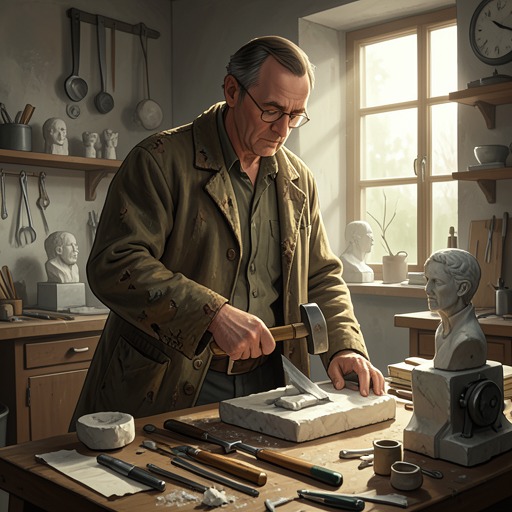
Goldmund next carves a wooden figure of Saint John, using Narcissus as his model. Niklaus hopes to include it in a crucifixion group on which the workshop’s two assistants have been working. Goldmund devotes himself to the work over an extended period, shaping the face and hands with patient concentration. When he completes it in a small shed behind the workshop, he sweeps the floor, brushes away the last sawdust, and stands before the finished statue for a long time. Completion becomes a rare, solemn experience, comparable in its gravity to a wedding, knighthood, or the birth of a first child. Art gives form to his friend’s remembered presence, but the finished work does not make Goldmund’s future certain.
As he considers leaving, Goldmund wonders whether the image of his mother may one day take shape through his hands and become visible to others. He cannot know whether this will happen. The mother may remain a dream, an intuition, or a sacred mystery; nevertheless, he feels called to travel toward her image and submit his fate to it. His vocation is therefore less a settled career than a direction shaped by memory and longing. Sculpture can make an image present, but it cannot guarantee that the deepest image will ever be fully captured.
On a later return to the bishop’s city, Goldmund finds that plague and unrest have changed the circumstances there. A governor has been sent to restore order, the bishop has left, and the epidemic has subsided by the time Goldmund arrives. The city’s upheavals do not displace his central concern: he has come back to the workshop where he hopes to work. In a cloister he also studies a newly painted Dance of Death, whose skeletal musicians accompany figures of every rank toward death. He recognizes its force as a warning of mortality, but distinguishes its lesson from what he himself has experienced. The image records death’s inevitability; his attention remains drawn to the particular, lived experiences that a general warning cannot contain.
Return to Mariabronn and Final Choice
Goldmund’s artistic life eventually returns him to Mariabronn, where Narcissus has become Abbot John. Goldmund feels small before the cloister’s powerful, quiet unity and the order over which his old friend now presides. He sees a difference between the learned, restrained Abbot John and the kindly, simple Abbot Daniel, yet recognizes that both serve the same institution and receive their dignity through it. The comparison revisits the religious world of Goldmund’s youth from the perspective of a man who once left it: personal temperaments differ, but the monastic order gives them a shared structure and purpose.
Goldmund prepares to work rather than merely accept the cloister’s hospitality. He finds an empty shed beside the courtyard gate and arranges for a drawing board and tools to be made to his specifications. He draws up a long materials list, inspects timber at the carpenter’s and in the forest, selects pieces to dry beneath a roof he builds behind the workshop, and works with the blacksmith and his son Erich to make the knives, chisels, drills, and planes he needs. These practical preparations show how his artistic calling depends not only on inspiration but on materials, planning, skilled labor, and a place to work.
For his first contribution to the cloister, Goldmund rejects the idea of making an arbitrary object. He wants the work to belong to the building and its daily life. Since the house has no need or room for an altar or pulpit, he chooses the unornamented raised niche in the refectory where a young brother reads from the lives of the saints during meals. He plans carved panels for the steps and lectern, joining the artwork to the community’s recurring act of reading aloud.
The design is divided into two parts: the world and the word of God. The lower section, a stair winding around a sturdy oak trunk, is to represent creation through images of nature and the simple lives of patriarchs and prophets. Above it, the parapet is to bear the four evangelists. Goldmund intends the figures to preserve particular people as well as religious types: one evangelist will carry the features of Abbot Daniel, another those of Father Martin, his successor, and Saint Luke those of Master Niklaus. The proposed lectern thus gathers nature, scripture, the cloister’s history, and Goldmund’s personal memories into one setting.
The return does not erase the difference between Goldmund’s life and the rule of the monastery. When he confesses, the father confessor is less concerned with Goldmund’s actual sins than with his neglect of prayer, confession, and communion. His penance requires a month of moderation and chastity before communion, attendance at early mass every morning, and three Our Fathers and one Hail Mary each evening. The episode makes clear that welcome within the cloister still carries expectations of ritual observance; Goldmund’s artistic work may find a place there, but his past has not made him simply subject to its discipline.
In his final conversation with Narcissus, Goldmund says he will stay and will not ride away again. He has no more desire for wandering, dancing, or women, and explains that he might have remained away for years had the world still offered him joy. Before he goes under, he wants to draw and make a few more figures; making art offers a modest pleasure worth keeping. His declaration is firm, but its reason is not a triumphant reconciliation of every conflict. He returns because his strength and appetite for the road have ebbed, and because he still wants to work. Goldmund’s story therefore closes on an intimate, limited choice: the former wanderer seeks shelter in the monastery and a last renewal of the craft that has always allowed him to give form to what he remembers.